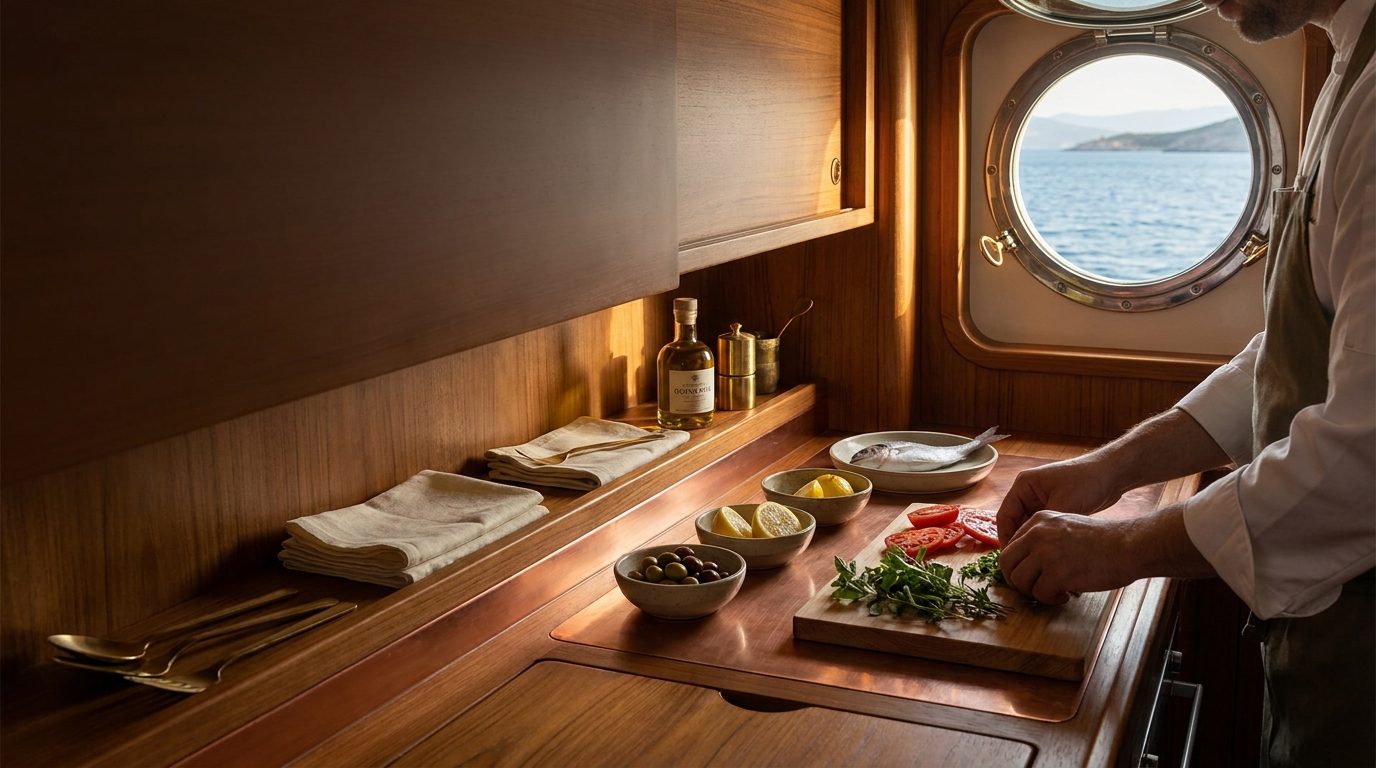
On land a chef has room: burners, counters, cold stores. At sea everything shrinks. The galley — a boat's kitchen — is often a space two people barely fit in; the counter is a door's width, the oven a drawer's height. And yet, three times a day, tables come out of that narrow space that rival a restaurant. The secret lies not in equipment but in discipline and freshness.
A Kitchen the Size of a Cupboard
In the galley everything has a place, and everything must stay in its place — because the boat moves. Pots on locking shelves, knives on a magnet, spices in narrow drawers. A good galley cook thinks of the kitchen like a chessboard: every move planned in advance, every ingredient within arm's reach. The space is limited, but the order can be limitless.
Cooking in a Swell
A boat calm at anchor heels and rolls under way. So cooking in the galley means cooking with balance: stoves stay level on gimbals, rails clamp around the pots, liquids are filled only halfway. An experienced cook also knows when to change the menu on a rough day — one pot instead of the oven, a sturdy stew instead of a complicated plate.
Market to Deck: Freshness Is Everything
At sea the greatest luxury is the freshness of the ingredient. A good galley programme begins at the morning market: fish caught that day, tomatoes picked that morning, warm bread from a shoreside bakery. Because the fridge is small, you shop little and often rather than stocking up — which means every meal changes with the season and the harbour. The menu follows the route.
Simplicity Wins
Perhaps this is the galley's finest lesson: constraint forces simplicity, and simplicity is often more delicious. Olive oil, lemon, fresh herbs, and good fish — in the middle of a cove, as the sun sets, you need nothing more. The narrow kitchen strips the chef of flourish and leaves the ingredient itself. The best food at sea is the least interfered with.
Perhaps the galley’s most beloved moment begins after the anchor goes down in the evening. The boat that fought the wind all day grows still, and small plates appear on deck: olive-oil dishes, a bowl of cacık, grilled octopus, sliced melon. This simple meze spread is what many guests remember most from a charter. For the cook it is the quiet reward for a whole day in a narrow kitchen — because a good table earns not applause but the silence around it. At sea, eating is less about filling the stomach than about closing the day.
PRIVATE CHARTER →