Anyone who looks at Bodrum's castle from the sea is standing, without knowing it, at the edge of a border. To the west, that mountain silhouette you can pick out with the naked eye isn't Turkey; it's Kos. The distance between them isn't a day's sail — it's a morning. The Aegean is narrow here; and through history, that narrowness has bound the two shores together far more than it has kept them apart.
For a passage out of Bodrum, the Greek islands aren't a distant dream; they're a natural extension of the route. You need only know which island comes into its own when — and the paperwork side of things.
Bodrum's Front Door: Kos
Kos is the nearest door on the opposite shore. It's known as the island where Hippocrates was born; just above the harbour stands an old plane tree in whose shade the father of medicine is said to have taught — not quite as old as the story, but sitting there makes you feel it might be. A castle left by the Knights, flat streets made for bicycles, and a harbour that returns to its own rhythm in the late afternoon. To leave Bodrum and take lunch in Kos is a matter not of distance, but of decision.
The Quiet Dodecanese: Kalymnos and Leros
Kalymnos, across from Turgutreis, is the island of the sponge divers; its cliffs now draw climbers from around the world, though the harbour keeps its old seafaring calm. A little further north, Leros opens onto another century with the strange, geometric town of Lakki, left from the Italian years. Both are islands where the crowds thin and the evening runs long — close to Bodrum, but far in spirit.
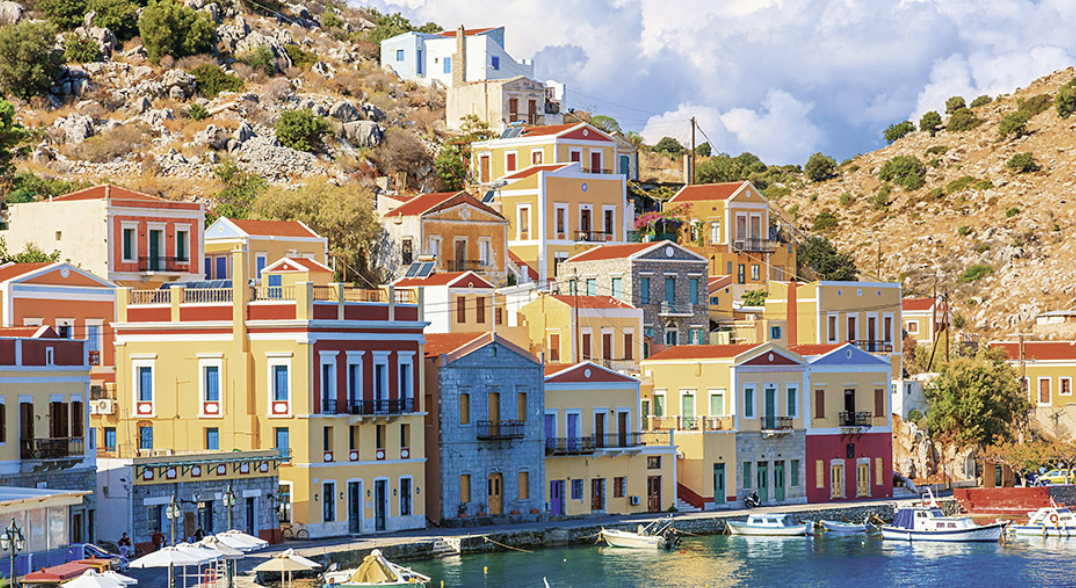
A Little Beyond: Symi and Rhodes
Come out from the Datça side and Symi rises before you: as you enter the harbour, the neoclassical façades stacked down the hillside line up as if waiting for you to step ashore. Further south, Rhodes is the opposite shore's grand finale; the Knights' walls, medieval lanes, and a town a single day won't exhaust. Symi asks for an afternoon; Rhodes wants a few days.
The Paperwork Side
The sea tells the lovely part; the paperwork is the hard part. For Turkish citizens there's a route that has grown easier in recent years: a single-entry, seven-day "visa on arrival" (express visa) covering twelve Greek islands. It began in 2024 and was extended for another year in 2026; it covers only the islands in the programme, granting no passage to mainland Greece or the wider Schengen area. One small but important detail: if the passport carries an entry or exit stamp from the TRNC, the visa isn't issued. Holders of green, grey and black passports are exempt in any case.
But that convenience is mainly for the ferry traveller. Arriving on your own keel — by yacht — changes things: you clear out of Turkey properly and clear into Greece at a port of entry such as Kos or Rhodes, with passports, vessel papers and formalities all in play. The rules shift from season to season, so the wisest course is to confirm the current position before you sail — or have it confirmed for you.
Once the papers are done, the rest is easy. As Bodrum's castle dissolves astern, the sea beneath you doesn't change at all. That water knows no border; it has run to the same islands on the same wind for thousands of years. And so do you: leaving one shore and arriving, by noon, at another — yet always on the same sea.
PRIVATE CHARTER →