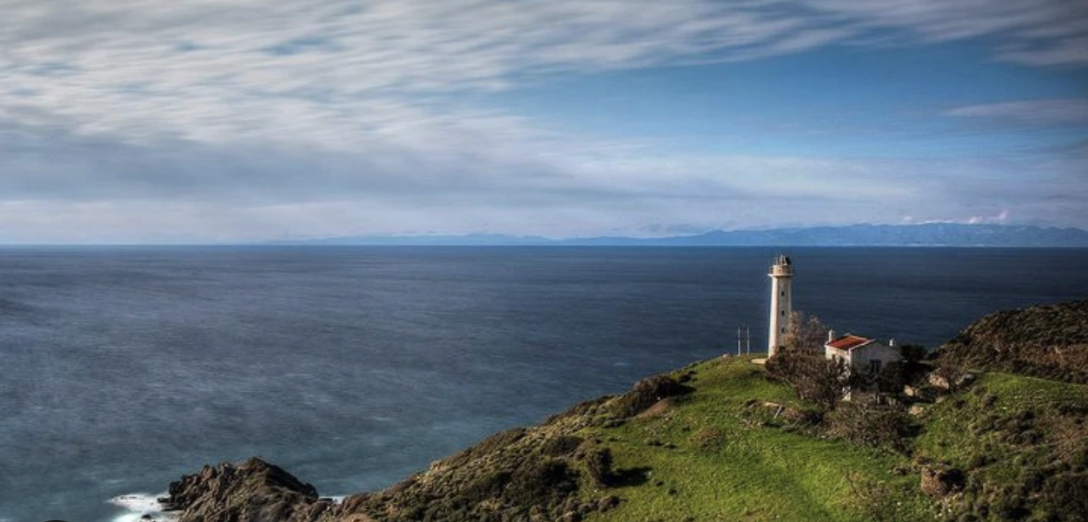
The Datça peninsula narrows as it runs west, and at its very end a headland rises, as if to say one last word to the sea: Deveboynu, the camel's neck, named for the shape it takes from a distance. A boat drawing near in the evening picks out a small structure on the height before dark falls. Then the light flashes: twice, then silence, then again. It is the plainest sentence at sea.
The lighthouse was built in 1931. It stands more than a hundred metres above the water; its tower is short, but its position is everything. For this is not merely a headland — it is the border of two seas: the Aegean on one side, the Mediterranean on the other. Behind it, the ancient city of Knidos; ahead, the silhouette of Kos.
A Watch Passed Down
The lighthouse's first keeper was Veli Bora; the watch later passed to his son, Birol Bora. A lighthouse used to be a family's home: the lamp filled, the glass wiped, the mechanism wound, and through the night that light kept from ever faltering. Most of the work was never lighting the flame — it was not leaving it alone. There are more than four hundred lighthouses along this country's coasts; and behind each, a watch like this, its keeper's name usually unknown.
Where the Word Was Born
Here a strange coincidence begins. The Turkish word for lighthouse, "fener," comes from that famous tower at Alexandria: the Pharos. The Lighthouse of Alexandria, one of the seven wonders of the world, was so renowned that its name became fáros in Greek, faro in Italian and Spanish, phare in French, and fener in Turkish. Now the real part: the architect credited with that Pharos was Sostratus of Knidos. So if we have a word like "fener" at all, at its root stands a son of this very headland — Knidos. Deveboynu, without carrying the name, stands in the word's homeland.
From a French Concession to Now
Behind the lighthouses lies a history more tangled than you'd think. In 1860 the Ottoman state granted the running of its coastal lighthouses to a French partnership — Collas and his associate — under concession; for years the lights burned under this half-foreign administration. The Republic later bought it back and nationalised it. Today automation and satellites have largely retired the keeper. The lights still burn, but the sun now turns most of them, and no one wipes the glass.
And yet, when you catch that flash in the dark some night, however accurate your GPS screen, something old in you settles. A lighthouse doesn't only tell you where you are; it tells you that you are seen. Deveboynu's light keeps repeating a sentence three thousand years old: whoever passes here is not alone. When morning comes the light goes out and the headland is ordinary rock again — but when night returns, the word is there once more.
ROUTE DESIGN →