Some tables have no road to them. Return to the cove in the late afternoon and you pick the jetty out from among the pines first: a few bulbs, two boats tied up, a grill trailing smoke. The engine falls silent, the boat noses in gently, and into the smell of salt and pine comes the smell of grilling fish. Some of the finest tables in the Aegean are exactly here — and the best way to reach them is from the sea.
This is the quiet side of the blue voyage. Everyone knows the pleasure of anchoring in an empty cove. But the real refinement is in those small places touched by a jetty; the ones with a short menu and a long story. Some have a road behind them, some do not. Arrive by boat, and they all begin differently.
Göbün: Same Family, Same Pot
In Göbün, one of Göcek's most sheltered coves, evening arrives early. You enter through a narrow mouth; once inside, the water settles. Göbün Restaurant is one of those old blue-voyage stops sailors have known for years. Anchor off and come in by dinghy, or tie to the little jetty. The mezes are homemade; but the cove's real fame comes from its crayfish pasta and its long evening tables. Lycian rock tombs stand on the hillside above. You come to fill your stomach, but what stays with you isn't the meal — it's where the table was set.
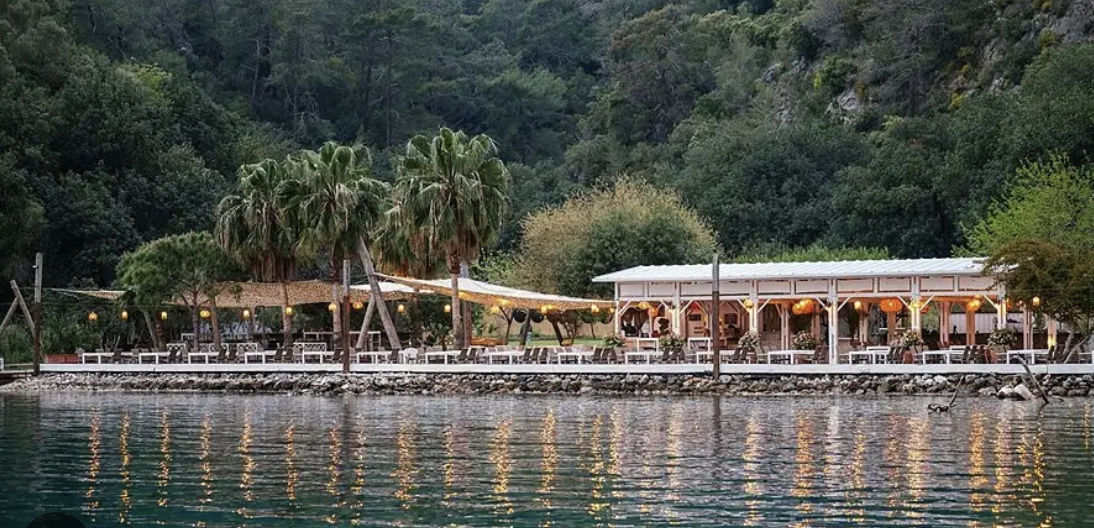
Jetty Tables in the Göcek Coves
A few names carry this tradition around Göcek. Kapi Creek is one of those places that slows the evening inside a narrow cove; once the wind drops, boats lie stern-to and the tables sit close to the water. Sarsala Restaurant is a more established stop, with its wooden pier, daily fish and the rhythm that can run from a noon swim into dinner. Adaia, on the Hamam Bay side, is a newer and more refined example: facing Cleopatra's Bath, it feels less like a restaurant than a small cove life reached by sea.
Then there is Tomb Bay. The jetty once known as Nomad, now often referred to as Likya, sits under the shadow of the rock tombs. By day you look at the hillside; by evening the stone changes colour. At these tables, the point is not only the fish or the meze. It is that the cove has prepared you before the plate arrives.
The Fish on the Rock
That is why Bedri Rahmi Bay stands apart. The cove once called Taşyaka was visited in 1974 by the painter and poet Bedri Rahmi Eyüboğlu on a blue voyage; he painted a fish on the rock at the entrance. He died the following year; the fish stayed. If its colours are still bright today, it is because volunteer painters quietly refresh them from time to time. As you enter, the fish greets you. And when you sit at the jetty table, above you are rock tombs cut in 350 BC. To have dinner in a cove is, sometimes, to see fifty years and two thousand years at once.
Bozburun Side: Less Light, Longer Evening
On the Bozburun peninsula, the tables are a little quieter. You enter Serçe Limanı through a narrow mouth; inside, the water goes still, as if a door has closed behind you. Captain Nemo's Farm Restaurant works almost like the harbour's only table: simple, close to the shore, open in summer, set among boats hiding from the wind. A little further north is Bozburun Yacht Club, another table remembered more from the water than from the road.
The names can be counted: Göbün, Kapi Creek, Sarsala, Adaia, Nomad / Likya, Captain Nemo's, Bozburun Yacht Club. But the list is not the point by itself. What makes these places work comes before the menu: the way you arrive. Whoever comes by land sits down hungry; whoever comes by sea has eaten the journey too.
By the time the engine falls silent, the evening has already begun.
DAY CHARTERS →