Late afternoon, off Kaş. The boat swings gently at anchor, the water begins to darken, the smell of pine drifts into the cooling air. From the shore this is an ordinary blue. But just east of the cape they call Uluburun, the sea drops away fast: forty metres beneath you, then fifty, then sixty.
And somewhere down there, for three thousand three hundred years, everything a single ship once carried has been waiting.
Metal Biscuits With Ears
In the summer of 1982, a young sponge diver from Yalıkavak — Mehmet Çakır — told his captain he'd seen something strange on the bottom: "metal biscuits with ears." The captain had worked with the museum in Bodrum, and he understood at once what the description meant. Those biscuits were copper ingots, cast in the oxhide shape of the Bronze Age. A single sentence, carried up from the deep by a sponge diver, became the doorway to the most important wreck in nautical archaeology.
Excavation began two years later and ran for eleven seasons. The team led by George Bass and Cemal Pulak made more than twenty-two thousand dives on that steep slope between forty and sixty metres. The sea does not give up what it hides easily; every piece was mapped, measured and lifted, one by one.
The Inventory of an Age
What came up was not simply a ship's cargo. It was the inventory of an age.
Ten tons of copper from Cyprus. More than a ton of tin — some of it from mines as far away as Central Asia. African logs the Egyptians called ebony. Elephant and hippopotamus ivory. Amber that had travelled all the way from the Baltic in the north. Cobalt-blue glass ingots, the oldest intact ones known. Hundreds of Canaanite jars filled with terebinth resin. Swords of Canaanite, Mycenaean, even Italian make. And a gold scarab no larger than a palm, engraved with the name of Nefertiti — the only one of its kind known in the world.
In the hold of a single boat lay very nearly the whole of the known world.
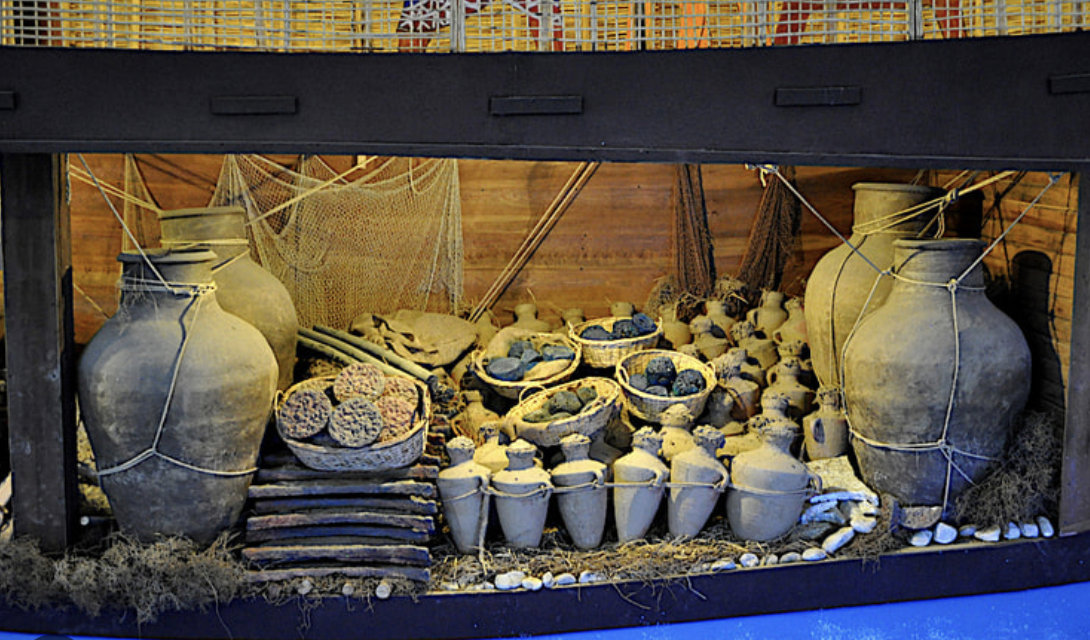
Even today no one can say for certain where the ship was from. Canaanite, Cypriot — it isn't settled. But her cargo speaks plainly: three thousand years ago this sea was a road that strung Egypt, the Levant, Cyprus, the Aegean and the distant north onto a single thread. While empires were being built on land, the real bond ran across the water.
The Things That Weren't Cargo
Among the load were things never meant for sale. A few figs, olives, almonds; cumin, sumac, coriander. A small folding wooden writing-tablet, one of the oldest known. A fishing line and a spear at the stern — someone had fished from there throughout the voyage. Three thousand years on, it isn't the copper that stops you. It's the fishing line.
Little of the ship herself survived, but what did had something to teach. The hull was Lebanese cedar, built shell-first rather than frame-first, the planks locked into one another. We'll see the same method again in Greek and Roman ships a thousand years later. Some truths of seamanship are found early, then not forgotten for a long time.
The Ship That Never Reached Port
We don't know why she sank. Perhaps a storm, perhaps a rock at the foot of the cape. The meltem stiffens here in the afternoon; perhaps that day too, while the sea looked flat, the tops of the pines had already given their warning. The ship never reached her harbour.
Most of the cargo now rests in Bodrum, inside the castle, in the Museum of Underwater Archaeology. Behind the glass: the ingots, the amber, the scarab. Step inside and you feel something odd — these don't sit there like museum pieces. They sit there as if still waiting to set out.
But the real thing isn't in the museum. The real thing is still out there, off Kaş, beneath that cape.
If you anchor there some evening, watch the chain go down into the blue. That blue has kept a secret for three thousand three hundred years, and it tells it without hurrying anyone: you are not alone in this cove. Someone passed this way before you — and did not get through.
ROUTE DESIGN →