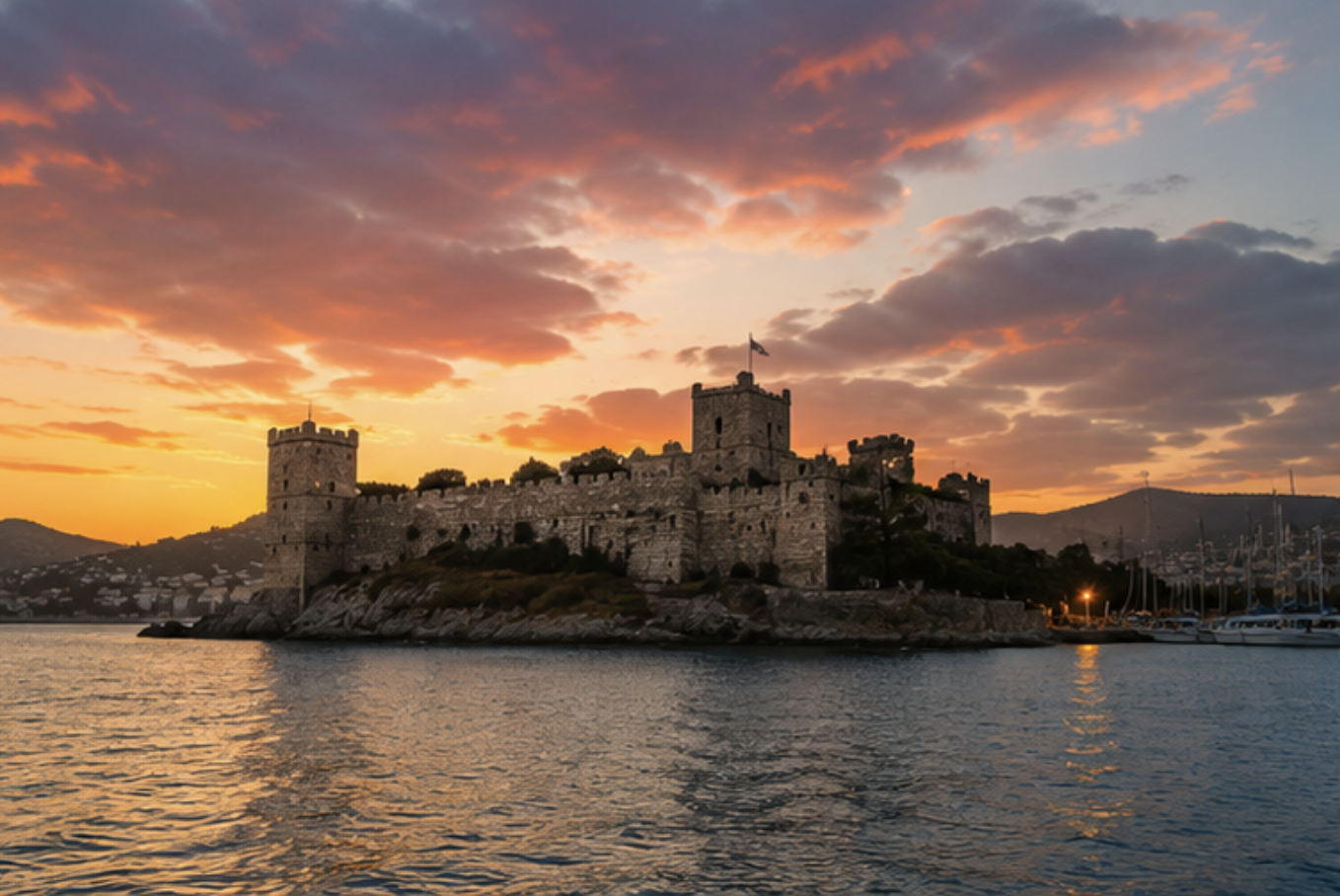
Approaching Bodrum from the sea as the sun begins to drop, the castle appears first as a shadow. Then the walls sharpen, the towers separate from one another, and the stone turns a warm colour — the day's last light always finds the highest point first. Most guests look, find it handsome, take a photograph. Few ask: how many languages have these stones spoken?
The castle's first name wasn't Bodrum. The knights called it after Saint Peter — "San Pietro." Over time the name softened in local speech into "Petronium," then contracted into what it's called today. A city took its name from a castle's name — a rare thing.
A Hundred and Twenty Years Under Construction
Building began in 1402. The builders were the Knights Hospitaller of Saint John, headquartered on Rhodes, looking for a secure foothold on the mainland against a rising Ottoman power. They chose Bodrum because it lay close to Kos, which was already fortified. But the castle was never the work of one nation — Italian, French, German and English chapters of knights each raised their own section in their own style. Which is why four separate towers still stand today, each bearing the name of its country; the tallest is the French Tower, forty-seven and a half metres above sea level. Construction, in fits and starts, took roughly a hundred and twenty years.
Borrowed Stone
Some of the walls came from elsewhere. In 1494, when the knights decided to reinforce the fortress, they used the stones of a structure that was already in ruins by then: the Mausoleum at Halicarnassus, once counted among the Seven Wonders of the World. The monumental tomb Queen Artemisia built for her husband had long since been brought down by an earthquake; its stones were carried to the nearest fortress on the water. Which means that today, when you rest a hand on the castle wall, the stone you're touching may once have been part of another grief, two thousand years old.
From Chapel to Mosque, From Prison to Museum
In 1523, after Suleiman the Magnificent took Rhodes, Bodrum Castle passed to the Ottomans too. The knights' chapel was fitted with a minaret and turned into a mosque. For the next four centuries the castle served mostly as a garrison, and now and then as a prison. After the First World War it stood empty for some forty years — no one quite knew what to do with it. Then, in the early 1960s, it became host to a cargo raised from the seabed: the Museum of Underwater Archaeology. Today, in the cool stone rooms of the English Tower, you can see the load of a ship that sank off Kaş long ago — the oxhide copper ingots, the amber, the scarab. The castle turned from a structure built for defence into one built for memory, but it never stopped standing watch.
Every boat today passes beneath these walls on the way in or out of harbour. Most guests look at the castle without really seeing it — take it for scenery. But every stone above has passed, in turn, through the hands of a temple, a knight, a sultan, a diver. When the evening call to prayer rises from the mosque just beside it, not from the castle itself, the sound seems to wander among the stones for a moment — as if still addressing everyone who once stood there, in every one of those languages at once.
Before you drop anchor, look up once, properly: as the sun goes down, as the French Tower holds the last of the light. That stone isn't trying to prove anything to you. It's simply standing there — with the same patience it has kept for five hundred years.
DAY CHARTERS →