Entering a cove, a good captain slows down, moves to the bow, and reads the colour of the water. Deep navy means depth; pale turquoise means sand; a dark, almost black-green means something else. The captain lets that patch go, drifts a few metres further, and only then lets the anchor down. Guests sometimes ask why not there instead of here. The answer is usually short: "That's erişte."
The local name comes from the shape of the leaf — thin, long, genuinely close to a plate of noodles. But what they call noodle-grass is, in fact, one of the most patient living things in the Mediterranean.
A Meadow Thousands of Years Old
Posidonia oceanica isn't algae; it's a true flowering marine plant, and its roots — its rhizomes — advance only a few centimetres a year, which is why a full meadow can take hundreds, sometimes thousands of years to form. It cannot be planted or farmed. It's called the "lung" of the Mediterranean because a single square metre can produce up to five thousand litres of oxygen a day; its roots lock carbon into the seabed at rates that outpace even rainforest, layer by layer. Fish fry grow up in it, sand holds together because of it, waves lose their force passing over it.
Once It's Torn Out
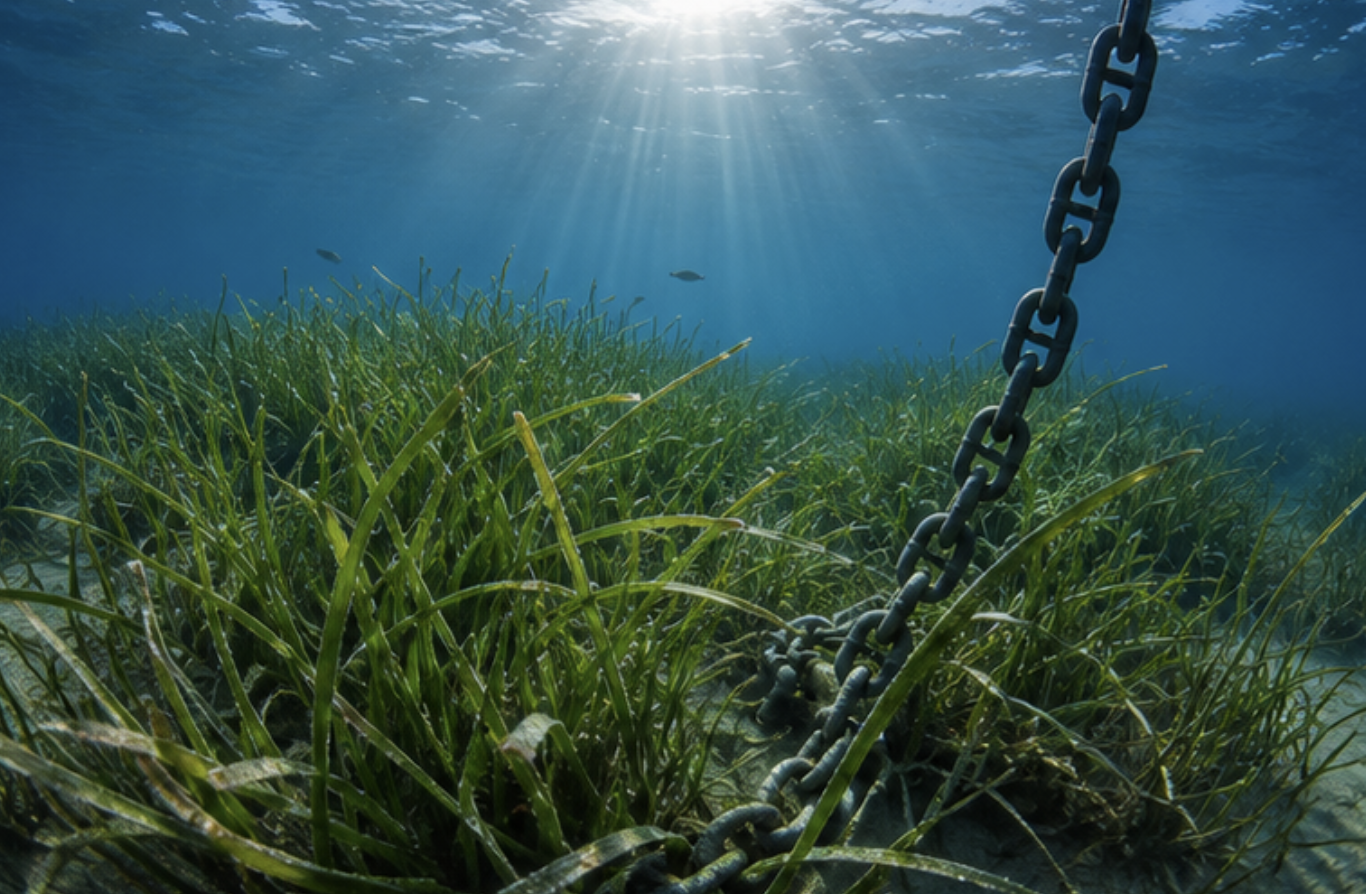
The trouble is that this meadow's worst enemy isn't a storm or pollution — it's a boat's anchor chain. As the wind shifts direction overnight, an anchored boat swings, and the chain sweeps the seabed, tearing the roots out where they stand. Pollution can sometimes be cleaned up. There is no known way to bring back a meadow once it's torn out. According to 2024 data, the Datça-Bodrum stretch was recorded as one of the most anchoring-pressured zones in the entire Mediterranean, precisely because of this — more than thirteen thousand anchorings logged there in a single year. Which means this isn't a story about some distant sea. It's a story about our own water.
A New Courtesy of Anchoring
In Fethiye-Göcek, they saw this problem and tried a solution: hundreds of moorings and buoys were laid across seventeen bays, none of them touching the seabed; boats now hold fast on fixed lines instead of dragging chain across the bottom. The system isn't everywhere yet, but the idea is spreading. For our own captains, the rule has stayed simple: sand, pale ground — anchor there. Dark green, a dense meadow — never. Sometimes that means anchoring fifty metres from the spot you wanted. It looks like a small sacrifice. But whatever's growing beneath you will outlive your boat by a very long time.
Next time you look at the colour of the water, don't just see a pretty turquoise. See a forest with a patience far longer than yours. Moving the anchor a little further off is a quiet kind of promise made to it.
ROUTE DESIGN →