In one of Bodrum's coves, even on a summer night, a sound still comes from certain gardens: the adze coming down on wood, a pause, then again. The smell arrives before the sound does — resin, fresh sawdust, a trace of tar. Come closer and you'll see it: a row of ribs, a hull not yet wearing its skin, standing in the moonlight like the bones of something enormous.
This isn't a show put on for visitors. In Bodrum, boatbuilding is a trade as old as the town itself.
Ziya Usta's First Gulet
What we now call the "Bodrum Gulet" first went into the water in 1958. The builder was Ziya Güvendiren, and the boat was a two-jib sailing vessel commissioned by her owners — Mustafa Biraki, Şevket and İbrahim Nalbantoğlu — for trawl fishing, fitted with a 152-horsepower Gardner engine. No one called it a "gulet" at the time; it was simply a boat, built to go to sea and bring back fish. It would be another decade before tourism rediscovered the shape.
From Apprentice to Master
The apprentices who left Ziya Usta's side to open their own workshops — Mustafa Denizaslanı, Mehmet Özyurt, Erol Ağan, Engin Denizaslanı, Ziya Tümay, Ali Kemal Denizaslanı — soon became masters in their own right. By 1975 tourism had taken off, and people were selling land to buy gulets; the idea of the blue voyage reshaped what had until then been ordinary fishing boats. In his own account, Erol Ağan says that when he arrived in Bodrum in 1986, his first job was finishing five half-built gulets left in a yard; he then built his own first boat, a transom-sterned gulet named "Meteor." Two names among the masters became legend: "Balık," launched in 1970, and "Elpenor," launched in 1974 — one loved to the point of obsession, the other remembered for her character.
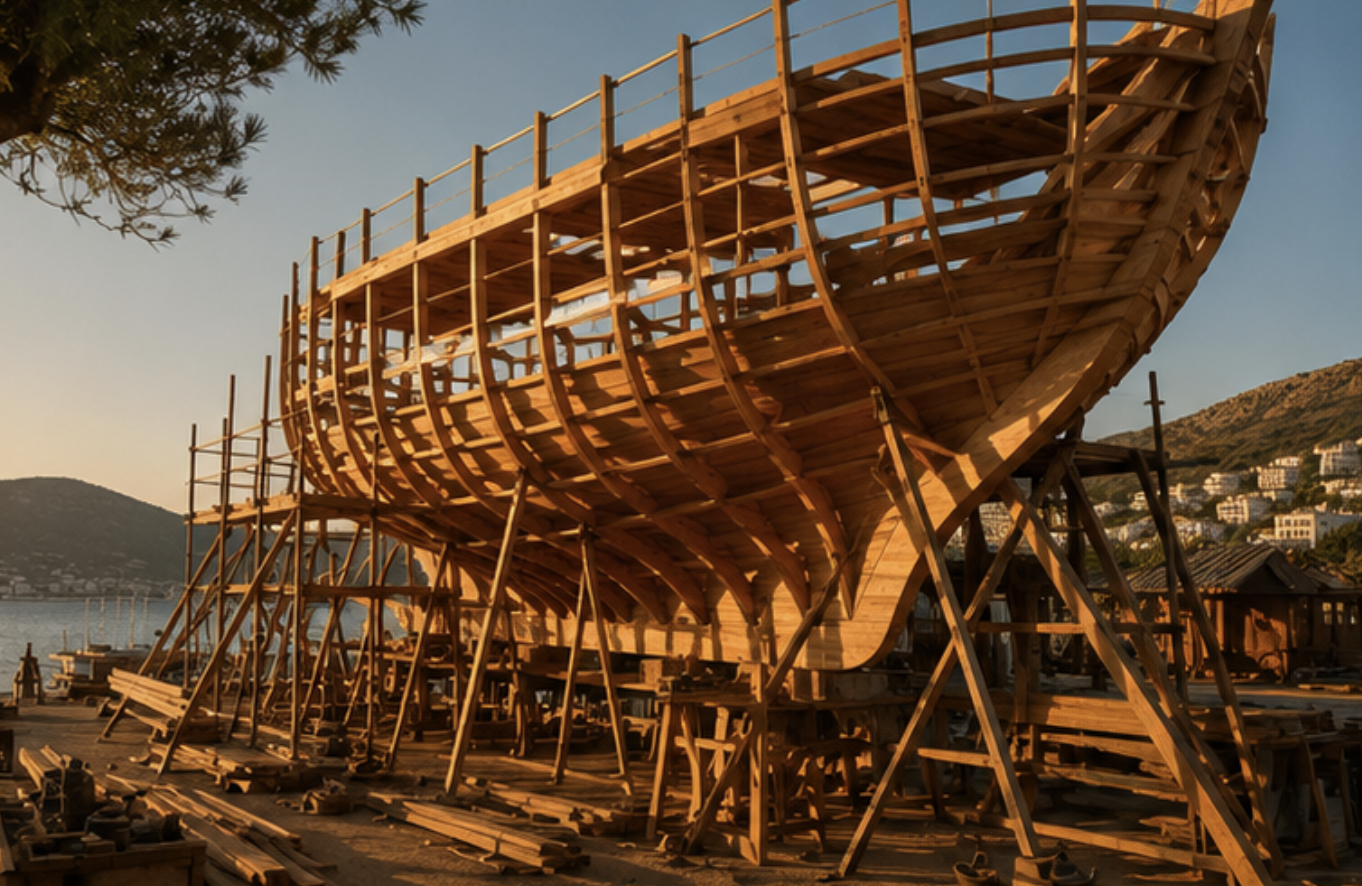
Choosing the wood is its own craft. Parts most exposed to the water, like the keel, are cut from teak, iroko or makore — first-class woods with a life of twenty-five years or more; oak, mahogany and chestnut go into the rest of the hull. Depending on size, a gulet takes anywhere from eight months to two years to complete, from the laying of the keel to the final coat, always with the same patience. The work has long since moved out from the centre of Bodrum, scattered now through the peninsula's coves — İçmeler, Çiftlik, Tavşanburnu, Gündoğan, even Gümüşlük and Yalıkavak. But wherever you go, somewhere close by there's a hand that once belonged to one of Ziya Usta's apprentices.
Next time you're sitting on deck, look down at the wood beneath you. Once it was a tree; then it became a boat in a master's hands; now it's carrying you. The distance between those two things is shorter than it looks.
YACHT BROKERAGE →