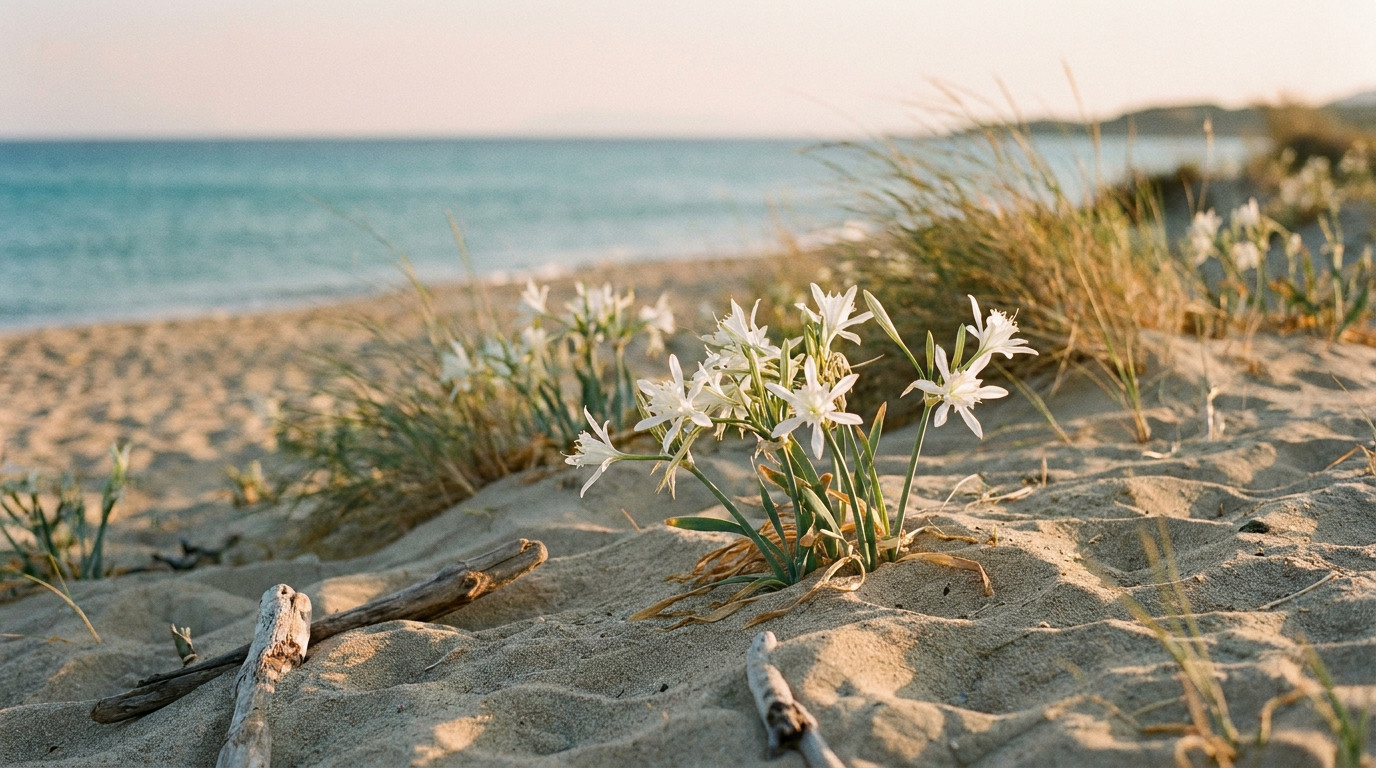
Picture stepping ashore by tender into a sandy cove, late in the afternoon, the sun already low. On a beach that looked deserted all day, up on the higher ground away from the water, you suddenly catch something white. Come closer and you see it's a flower: long thin leaves, six-pointed, paper-white. But what stops you isn't the sight, it's the scent — light, sweet, a little like lily; it comes out as the sun goes down, as though it had been hidden all day.
The flower is called the sea daffodil. It has other names in the botany books, but on the beach this one suits it: a lily that grows in sand, and lives nowhere but sand.
Why It Scents the Evening
There is a reason the sea daffodil gives off its scent at dusk rather than in daylight. Its pollinator is a moth that flies in the dark; the flower keeps its scent for that hour because that is when it expects its guest. So the sweetness that reaches you on the beach isn't written for you at all — it's an invitation meant for someone else. Much at sea is like this: we often take a thing for our own, when in truth we are only passing by it.
The flower opens in midsummer, all through August, while the sea is still warm and the land is parched. So seeing it is a little like a sign of the season: if the sea daffodil is out, summer has ripened.
The Root That Holds the Sand
The unseen side of the sea daffodil matters even more. Its bulb goes deep into the sand and its roots spread a wide net; that net holds together sand the wind and the waves are forever shifting. So the flower isn't only lovely, it's industrious — a quiet worker that keeps the beach from scattering itself. Picking one looks harmless, but if the bulb is damaged a replacement may not come for years. That is why in most places it is protected.
For a charter guest what follows is simple and practical: when you step off the tender onto a sandy cove, mind that strip of dry sand just above the water. Sometimes there are a few green clusters there, sometimes flowers already open. It's enough to walk past without treading on them, take a photograph and leave it be. There's no need to pick it; picking it ends the scent, and the invitation meant for that evening, all at once.
On your way back to the tender, look behind you: the flower stays where it is, still giving its scent to the sand. You leave, it remains; and next summer, in the same sand, it opens white again.
DAY CHARTERS →