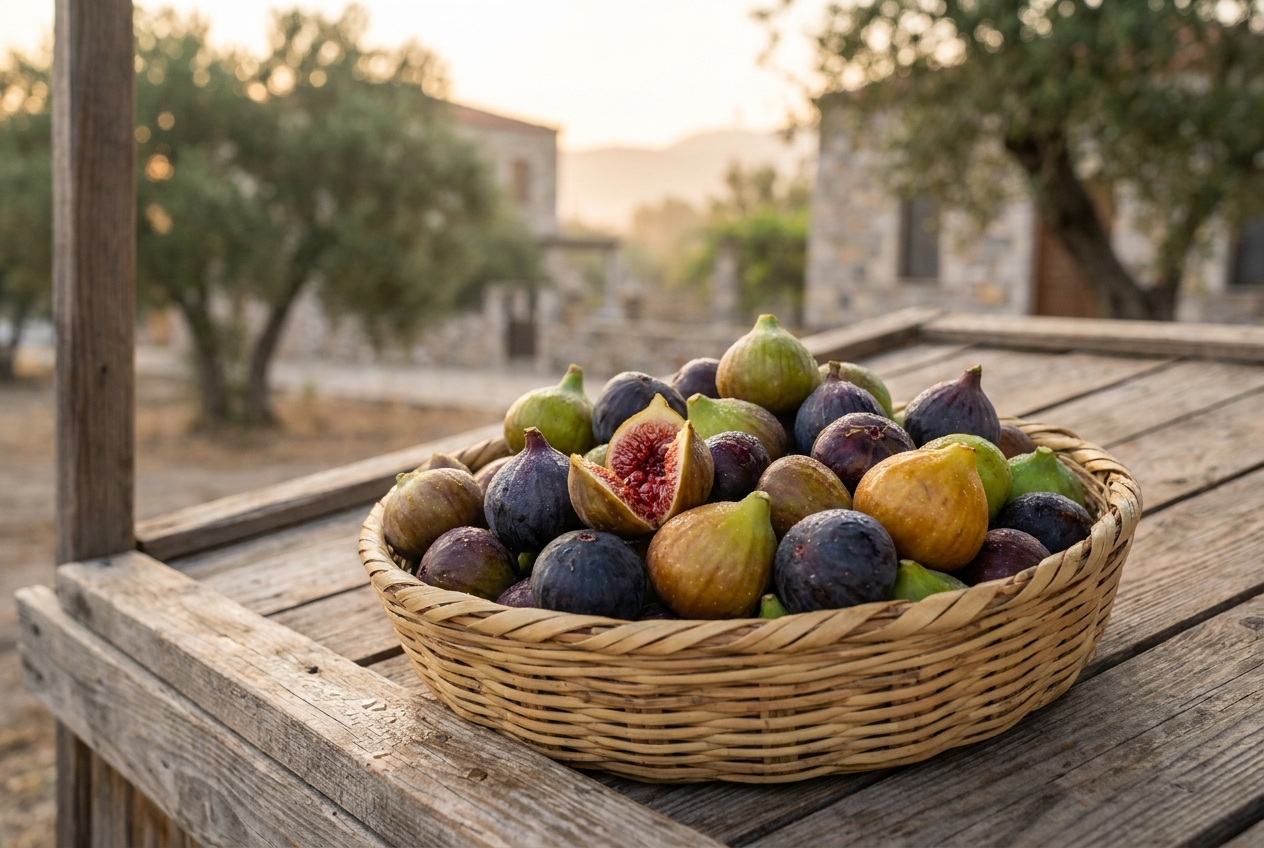
A ripe fig will not sit still in the hand. The skin is thin, a bead of honey wept from its base, on top of it the cool of morning left as dew; hold it and it gives, slightly. Its scent seems to reach the palm before the nose — that warm, dark sweetness with a trace of leaf folded into it. Bite it and the inside still seems to carry the day's heat. August in the Aegean is the month most things slow down; but the fig, contrary to all of it, is a hurried fruit.
Because there is little time between its ripeness and its spoiling.
Why So Short
The fig's inability to wait is not temperament but structure. When it comes fully to point on the tree its inside softens so far that it does not take to carrying, to long roads; and so the best of it is always found in the nearest market, right beside the village it was picked in. The firm, greenish ones lined on a supermarket shelf are another thing — they are picked early so they will bear the journey. In the coastal villages the fig is picked in the morning, on the market stall by noon, on the table by evening. Some say the best fig is never sold at all; it is eaten under the tree, where it fell. It may be an exaggeration. But it tells you well why the fig is such a local fruit: to know it, you have to be beside it.
How It Comes to the Table
On deck the fig needs no dressing. Most often the right thing is to split it in two and leave it — a little white cheese beside it, perhaps a handful of walnuts. The salt and the tang of the cheese balance the fig's honeyed softness; on old tables the pairing does not sit side by side for nothing. One boat cook holds it back overnight for the morning table, another serves it in the late afternoon, as the sun comes down, beside something cold. The secret is not in the recipe but in the timing: a day late and the fig turns into another fruit. If you happen upon it, eat the ripe one that day; keeping it for tomorrow rarely works.
There is a dried fig too, but that is another story. Inland in the Aegean the fig is dried in the sun and kept for winter; then the sweetness concentrates, the fruit shrinks, its texture changes. Both are the work of the same tree, but they are not the same thing. What a summer boat is after is nearly always the fresh — the dried comes to mind in winter, beside the stove, beside the tea. Perhaps this is another of the sea's lessons: everything has its season, and every season its own state.
On the way back from the market, look at the bottom of the basket. The ripest always sink, bruised a little from touching one another. Eat those that evening. The fig rewards not what is kept, but what is eaten in time.
ATLAS by OXYGEN →