In the 4th century BCE, a philosopher in Athens began telling a story no one could ever confirm. In his dialogues *Timaeus* and *Critias*, Plato spoke of a vast island standing in the middle of the ocean, beyond the Pillars of Hercules — what we know today as the Strait of Gibraltar: Atlantis. The story was so vivid, so detailed, that for centuries people have argued over whether it was history or allegory. But the least-known part of the tale isn't the continent itself — it's the king who gave it his name.
A God's Love, a King's Birth
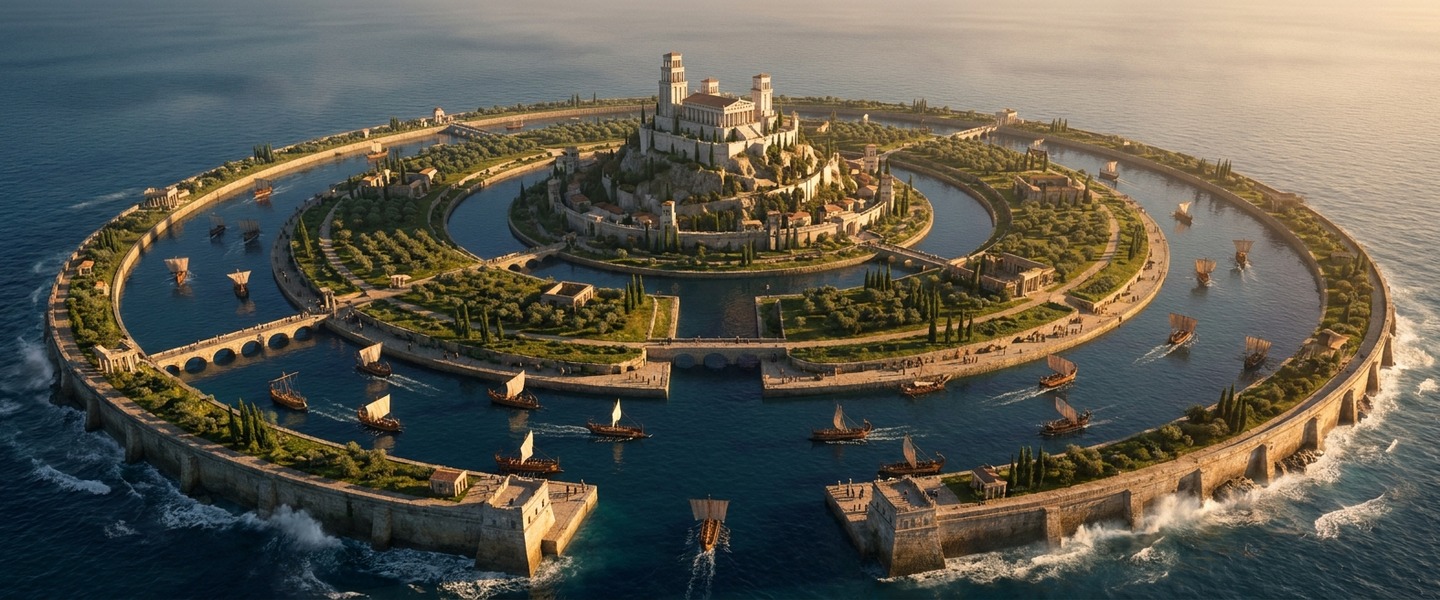
According to Plato, Poseidon, god of the sea, fell in love with a mortal woman named Cleito. To protect her, he encircled the hill where she lived with alternating rings of water and land, five in total — a place almost impossible to reach from outside, a labyrinth perfect in its own design. Poseidon and Cleito had five pairs of twin sons, and the land was divided into ten portions, one for each. But the firstborn received the largest share and the highest title: Atlas. Inheriting the central hill and the lands around it, Atlas became the first king of Atlantis.
There's a detail in Plato's text that strikes anyone interested in maritime history: both the continent's name and the ocean surrounding it trace back to Atlas. Which means that every time we say "Atlantic Ocean," we're unknowingly invoking the name of a king.
In Plato's description, Atlantis's capital opens with a great harbor that welcomes everyone arriving by sea: on the outermost ring of the walls, ships dock, goods are unloaded, and different languages mix in a lively quay. It's a harbor scene described in unusual detail for an ancient text — almost as if Plato were narrating through the eyes of a visitor arriving from the sea. Atlas's kingdom was imagined as a civilization with its gates open to the water, welcoming everyone first at that very quay.
A Sea's Knowledge, Inherited from a Father
What stands out in Atlas's story is that he isn't just a king — he's also a figure carrying forward his father's legacy. As Poseidon's son, Atlas is held to possess an innate knowledge of waters, currents, and the nature of the sea itself, much as kings in ancient narratives were often endowed with a kind of divine competence. In the legend, the island is described as an advanced maritime power, complete with harbors, shipyards, and fleets. At the root of that maritime power lies the idea of a king who learned the sea from his father.
This was the detail that moved us most when choosing the name. Atlas doesn't invent knowledge — he inherits it, then shares it. He doesn't speak from above like an expert; he passes on what he knows the way one passes down an inheritance. That's exactly the tone we were after in designing Oxygen's digital guide: knowledgeable, not condescending; sharing, not distant.
It was no coincidence that the first king of a continent was the son of the god of the sea — the story of Atlantis was, from beginning to end, a story about water, boundaries, and the horizon.
A Name's Two-Thousand-Year Journey
Whether Atlantis itself was ancient fact or a political allegory of Plato's own making remains an open question. But the influence of the name Atlas became indisputably permanent. Centuries later, European sailors and cartographers gave that very name to the great ocean they had newly charted: the Atlantic. And as one of the most recurring figures of the ancient world, Atlas gradually became an archetype for "knowing what lies beyond the boundary," for "seeing past the horizon" — king or not, the name always evoked the same thing: finding one's way through unknown waters.
A boat sailing the Aegean and the Mediterranean today is, in a sense, still moving through the waters where this ancient story continues. Just as the legend of Atlantis points beyond the Pillars of Hercules, every voyage is a step beyond the edge of the known. Perhaps that's why, for ancient sailors, what lay beyond the horizon was always something both feared and longed for — and the name of the king who first imagined that place still lives on today, on our charts, in our oceans.
Why We Chose This Name
When we first searched for a name for a digital guide, the obvious candidates were the predictable ones — an assistant, a bot, a helper. None of them captured what we were actually trying to build. We wanted a guide that shares knowledge rather than sells it; a voice that points the way rather than gives orders. When we revisited the story of Atlas, we found the three things we were looking for: a knowledge of the sea inherited from a father, a kingly bearing free of arrogance, and a gaze that always points beyond the horizon, toward the unknown.
So we took his name: Atlas by Oxygen. A guide that knows the routes, the bays, the seasons, and the stories of the Aegean — much like its namesake from millennia ago, pointing beyond the horizon while making the journey alongside you. Cleito's hill, Poseidon's five rings, the land divided among ten brothers — none of it has ever been found in an excavation, and probably never will be. But whether a story is true sometimes matters less than what it makes us feel. And the story of Atlas has always made us feel the same thing: knowledge isn't meant to be carried alone, but shared; direction isn't meant to be pointed at from a distance, but walked together.
ASK ATLAS →