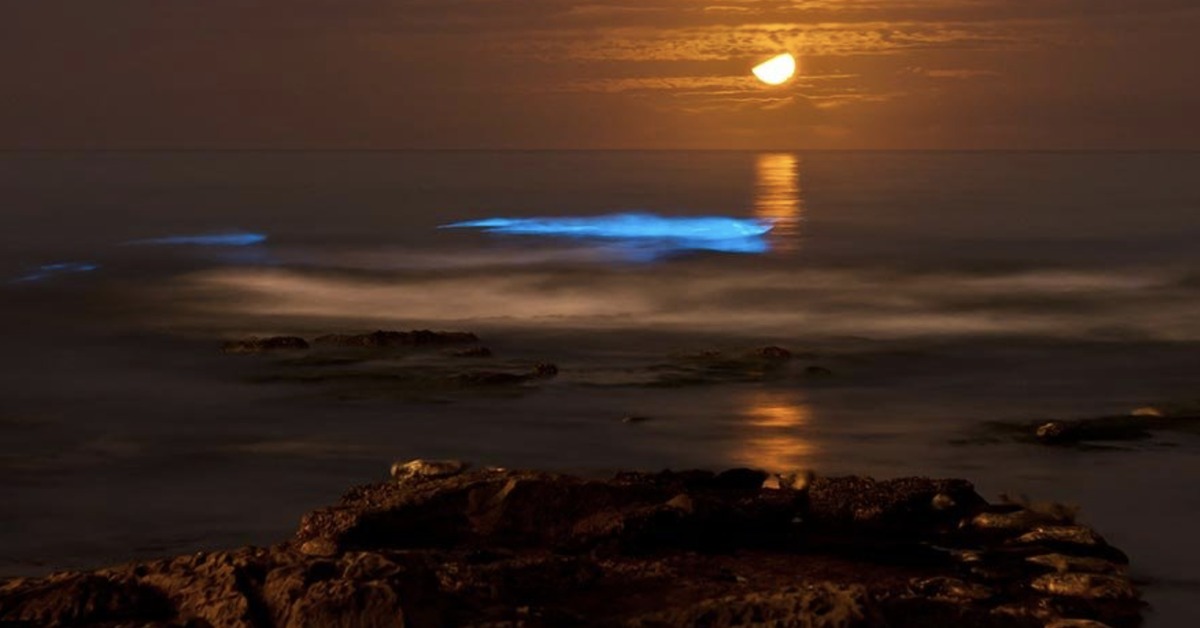
It's midnight. You jump from the deck into the water. A splash, a collision, then darkness. But then — a few seconds later — everything around you begins to glow. Every movement of your arm leaves a trail of light; beneath your legs, blue-green sparks spiral; you seem to be swimming inside a cloud of stars. For a moment you think the sea is producing its own light. And in a way, you're right.
Who Makes the Light?
The cause of this sight is neither an atmospheric phenomenon nor a chemical spill. It's microscopic organisms: dinoflagellates. These single-celled creatures, part of the ocean's plankton, possess an ability called bioluminescence — in short, they produce their own light. In doing so, they convert chemical energy directly into light, releasing almost no heat in the process. Biologists call it "cold light."
The mechanism works like this: when a dinoflagellate cell receives a physical stimulus — a wave, a hand, a fish tail, someone's arm — a molecule inside the cell called luciferin combines with an enzyme called luciferase and reacts with oxygen. This reaction produces light. The entire process takes place within milliseconds; by the time you have moved your arm, they have already flared and faded, waiting for the next disturbance.
The sea can make its own light — but only when the right organisms are in the right water at the right time of year.
Why Light? Why Blue?
From an evolutionary standpoint, why bioluminescence developed is not fully settled, but the most compelling hypothesis is this: the light is a defence mechanism. A small shrimp or fish trying to eat a dinoflagellate may startle and retreat when confronted with sudden blue flashes. Or the light may attract a larger predator, turning the small creature eating the dinoflagellate into prey itself. An alarm system, a trap, or simply a reflex — science hasn't given a definitive answer yet.
The blue-green colour is no coincidence either. Seawater rapidly absorbs other wavelengths of light — red, orange, yellow — but carries blue-green wavelengths far deeper. For an organism producing bioluminescence, blue-green is the colour that travels furthest underwater. Evolution chose what was practical.
Where and When Does It Appear?
Seeing bioluminescence in the Aegean requires timing, not luck. Dinoflagellates prefer warm water; their density peaks in summer, particularly during July and August. Deep, sheltered coves offer far more intense displays than open water — because the plankton concentrates instead of dispersing with the current. Nights with little or no moonlight are ideal; the darker the cove, the more visible the light.
The Gulf of Gökova, the Gulf of Hisarönü and the quiet coves along the Datça peninsula are among the Aegean spots where this phenomenon is most reliably observed. But a precise address is hard to give — dinoflagellates migrate, shift with the currents. A cove that is extraordinary one night may be ordinary the next. That is what makes it not a predictable show, but a genuine surprise.
What Should You Do to See It?
Technically, all you need to do is enter the water in a dark cove on a calm night and move. But a few small details amplify the experience. Enter quickly rather than slowly — a sudden impact disturbs more cells at once. Swim with wide, sweeping arm movements. Once your eyes have adjusted to the darkness — it takes a few minutes — the amount of light you see increases noticeably. And if you're fortunate, you might catch a fish passing by: a silhouette in the dark, visible only by the light it leaves behind.
Bioluminescence is not dangerous, not harmful to health, and has nothing to do with water pollution — quite the opposite: the waters where this phenomenon appears most intensely tend to be clean, healthy ecosystems. Dinoflagellates cannot reach this density in polluted water. When the sea lights up around you in the night, it is a good sign about where you are.
Come morning, the same cove looks entirely different — transparent, still, innocent. No trace of what happened in the night. But you know: beneath the surface, millions of small organisms are still there, producing light in milliseconds, waiting for the next movement.
ROUTE DESIGN →