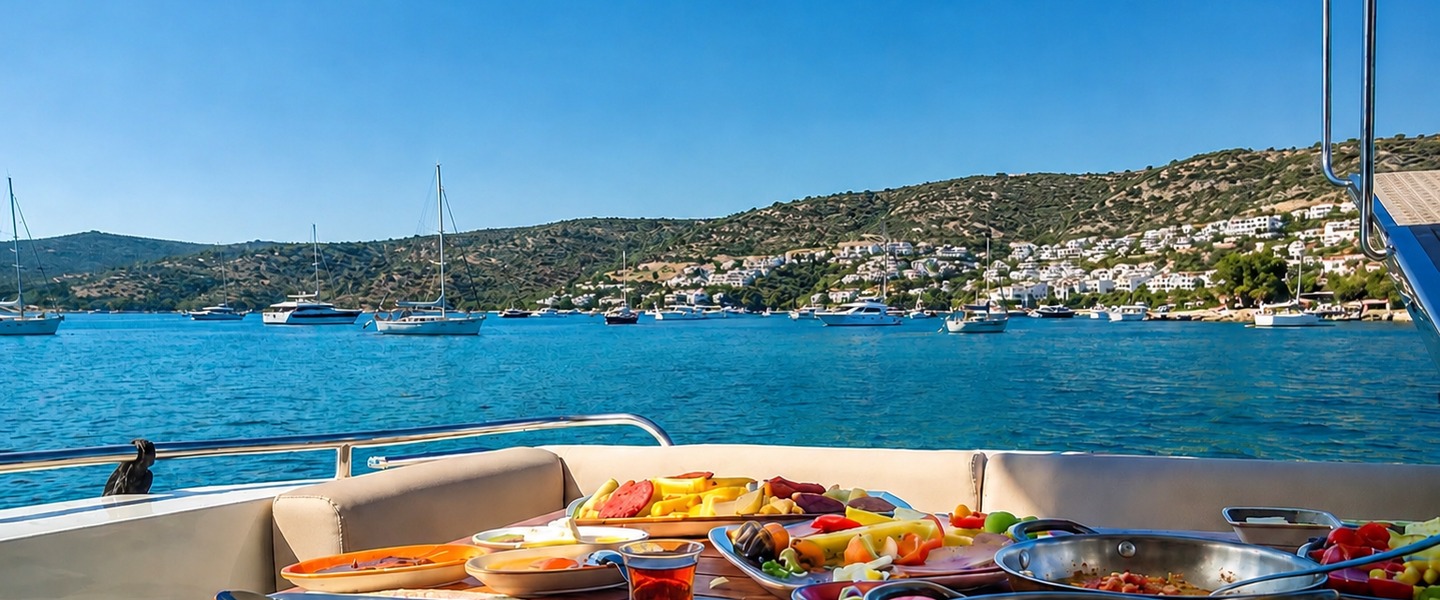
The sun hasn't fully risen, the cove is glass. The boat moves slightly — no engine, no wind, only the sound of water. A sound comes from the galley: the click of a kettle, a knife touching the counter. A few minutes later a table appears on deck: white cheese, black olives, tomatoes, cucumber, honey, butter, fresh bread. Perhaps eggs, perhaps jam. And always tea — brewed, strong, in a thin glass. You cannot set this table in any hotel in the world. Because what is missing isn't the ingredients: what is missing is that morning, that cove, that silence.
The Logic of the Trio: Olives, Cheese, Tomatoes
At the heart of an Aegean breakfast are three ingredients — and this trio is no coincidence; it is the geography itself. Olives are the oldest agricultural product of the Aegean coast; white cheese is the heritage of a landscape where sheep and goats have lived alongside the sea; and tomatoes grow so well in Aegean soil that in season, nothing else compares. When these three appear together, whatever else is done, the table tastes of the Aegean.
But detail matters. The olives should be dressed with oil and thyme — plain olives can feel heavy on deck. The cheese should be fresh, salty but not sharp. The tomatoes sliced as if torn by hand, with salt and olive oil. These small touches carry the same ingredients somewhere entirely different.
The Place of Tea
In the Aegean morning, tea is drunk rather than coffee — this is not a preference, it is almost a rule. The brewing ritual of Turkish tea suits the morning tempo on deck: it takes its time, it waits, it is served when the colour is right. Being served in a thin glass is also functional: the warmth is felt in the hand, and this matters in the coolness of a cove morning.
Experienced sailors prefer the second brew — the first is too strong, the second is balanced. And on the morning deck, tea is not only a drink: sitting with a warm glass in hand, looking out at the cove, doing nothing — this is also part of that table.
The secret of breakfast on deck lies not in the ingredients but in the timing: not so early that it is still dark, not so late that the sun is already hot. That window in between is the Aegean's finest hour.
The Question of Eggs
Eggs are the most debated element of breakfast on deck — they require cooking, and this is not always simple in a small galley in the early morning. But a good cook knows: menemen, fried or soft-boiled, all three are solvable on a small gas burner. Menemen is particularly preferred because it can be made in quantity and brings a warmth to the deck table — its smell carries differently in that morning air.
On some boats the captain sits at the same table as the guests; who makes the eggs is sometimes settled the night before. This small arrangement makes the morning more particular: a moment when the distinction between crew and guest dissolves, and everyone is simply there, in that cove, on that morning.
The Table Has No End
There is one more quality of the Aegean deck breakfast: it doesn't finish. At a city breakfast, the bill arrives, people stand, they leave. On deck, no bill arrives. The tea runs out, more is brewed. The bread runs out, it is cut. Someone wants to finish the cheese, it is finished. Something else is wanted, if it can be found, it comes. This table continues until everyone wants to get up — and most of the time, no one does.
As the sun rises the cove begins to stir: another boat drops anchor, a distant engine sound arrives, gulls pass over the deck. That moment announces that the morning is ending. The table is cleared, the first decision of the day is made: where to go, when to weigh anchor, how many miles today. But before that decision is made, a few more minutes are spent sitting. Because that table will not be the same again — the same cove, the same day, the same light, not again.
PRIVATE CHARTER →