At the sharpest tip of the Datça peninsula, where land surrenders to sea, two harbors stretch out, facing away from each other. Today this is a quiet ruin shared by wind and gulls. But in the 4th century BC, Knidos was the most talked-about address in the Mediterranean — and the reason was a statue: humanity's first nude female deity, carved by Praxiteles himself, Aphrodite.
The Statue That Was Rejected — and the One That Wasn't
The story begins with Praxiteles, the most celebrated sculptor of his age, producing two versions of the same Aphrodite. One depicted the goddess in traditional dress; the other showed her nude, caught mid-motion before a bath, instinctively reaching to cover herself — an audacity unseen until that point. The people of nearby Kos, offered first choice, found the nude version improper and chose the conventional one instead.
Knidos did the opposite. It accepted the daring version — and changed the course of history. The statue was placed in a round temple built on the city's most visible hill, designed so that visitors could walk entirely around it and view the goddess from every angle. Within a short time, Knidos had become not just a port city, but the art-pilgrimage destination of the ancient world.
Sailing Just to See a Statue
According to ancient accounts, wealthy travelers and philosophers of the time arranged special voyages to Knidos for the sole purpose of seeing this statue. Some entered the temple and walked behind the figure to view it from every side; others were content to look from the sea, because the temple's position had been carefully calculated so that the goddess's silhouette would be visible to every ship approaching the harbor.
To remember a city not by its temple, but by how that temple looked from the sea — this may be Knidos's true legacy.
Two Harbors, One Strategy
Knidos's geography was no accident. At the very tip of the peninsula sat two separate harbors — one opening north to the Aegean, the other south to the Mediterranean — one for trade, the other for the navy. This position turned Knidos into a natural checkpoint for sea traffic between the two seas. Ships stopped here not only for cargo, water, and provisions, but — as legend has it — for a blessing too: visiting Aphrodite's temple and leaving an offering before a long Mediterranean voyage was a common custom among sailors.
This belief went beyond the statue's aesthetic value. The goddess of love and beauty was also considered a patron of the sea — after all, in her own origin myth, Aphrodite was born from sea foam. Stopping at Knidos was, for a sailor, both a cultural pause and a symbolic insurance policy.
The Disappearance of the Goddess
The statue's end was as dramatic as its life. During the Roman period, emperors repeatedly offered to buy it from Knidos, but the city refused — the statue was its greatest source of income, and losing it meant losing its identity. Eventually, probably in the 4th or 5th century AD, the statue was moved to Constantinople and displayed in a palace collection. The palace later suffered a fire, and the statue was lost in it — or at least, that is where the record goes silent.
Not a single fragment of the original survives today. But its influence never disappeared: Roman sculptors produced so many copies and interpretations that today, from the Vatican to the British Museum, dozens of statues are classified as "Knidian Aphrodite type." None are the original — but each is an echo of something that once existed in Knidos and changed the world.
Anchoring at Knidos Today
Today, the truest way to arrive at Knidos is still by sea — that was always the city's main road. A guest approaching by yacht sees almost the same view a pilgrim saw two thousand years ago: the stone tiers of the amphitheater rising on the hillside, the temple's foundation stones peeking through the greenery, and the two harbors still standing with their arms open. In the late afternoon, as the sun drops behind the peninsula, a sunset watched from a boat anchored in this bay may be the closest thing left to feeling Aphrodite's presence here still.
A Custom Still Told
Among the older fishermen of the region, there is a story that the first crew to anchor in Knidos bay would pour a splash of wine — or a handful of seawater — back into the sea, with a quiet wish for safe passage. Its origin is unclear, perhaps a habit filtered down through centuries — but it is not hard to imagine it sharing the same root as the confidence Aphrodite once offered ancient sailors. Some legends survive not by law, but by repetition; and in the quiet of Knidos, that repetition continues.
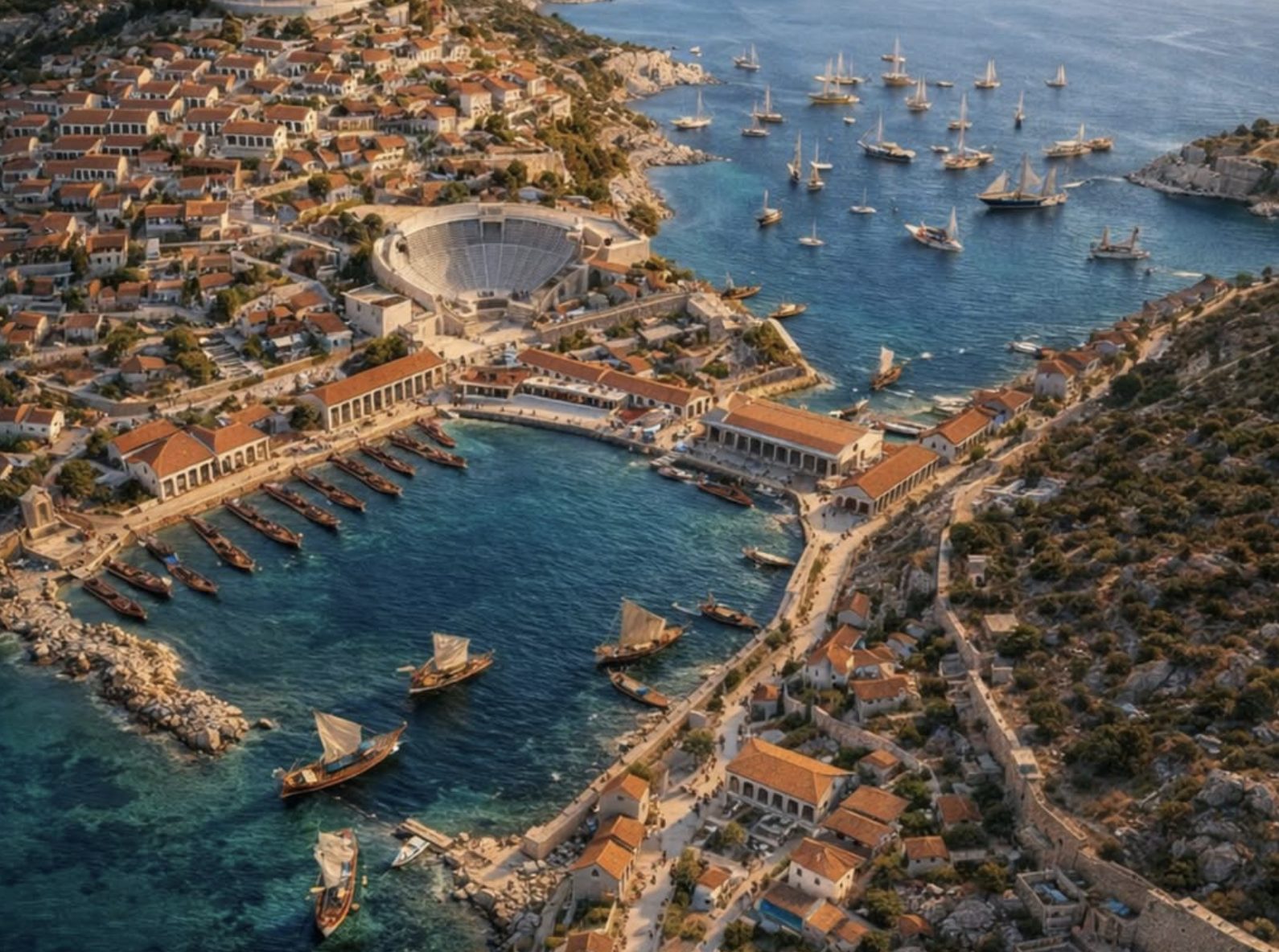
The temple's stones now mostly lie on the ground, moss-covered and worn by time. But for anyone standing at that tip of the peninsula, looking out at both harbors at once, it is not hard to understand why this place was chosen: the light falls differently here, and the sea opens up in a way it doesn't elsewhere. The statue may be gone, but the way of seeing that brought it here — a gaze that comes from the sea, looks at the sea, and gives thanks to the sea — still lingers in this bay.
ROUTE DESIGN →