At Kekova, cut the engine for a moment. Let the surface fall flat as glass and the swell go still. Then lean over the rail and look down — and you will see a staircase. Worn stone, draped in weed, descending into the water and vanishing into the blue dark.
Someone once walked down those steps. Swam, washed their linen, tied up a boat, called out to a neighbour. Two thousand years ago. Today your yacht rocks above that staircase; beneath it, the memory of an entire town lies sleeping.
The waters of Kekova are not a graveyard — they are a memory. And the Mediterranean hides far more than it shows along its shores.
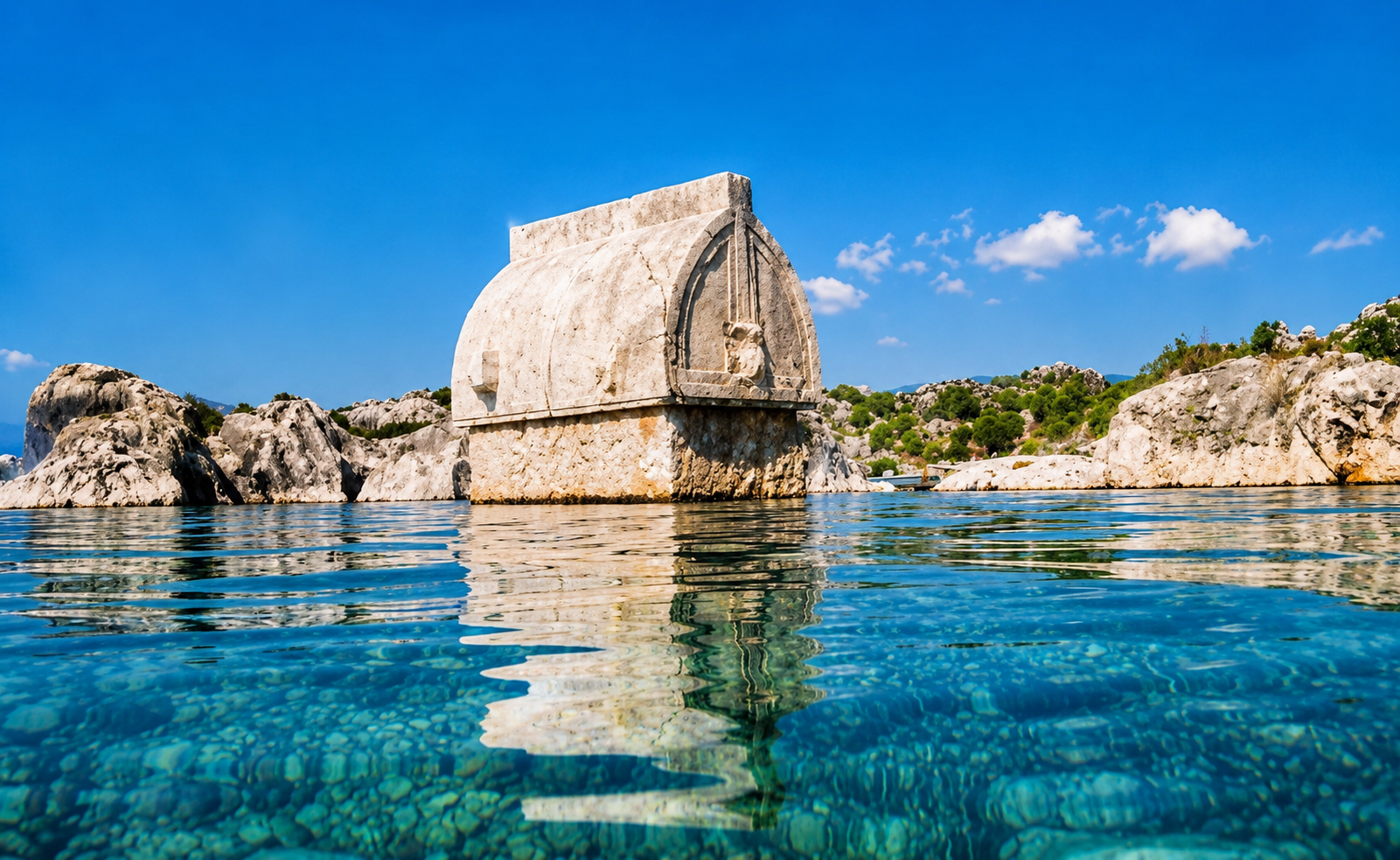
The Sunken City of the Lycian coast, Kekova — ancient stone asleep just beneath the clear water.
The Waters That Rose in a Single Night
The story begins in the 2nd century AD, on the Lycian coast. Along the northern shore of the long, bare island we now call Kekova lay a harbour town named Dolichiste — a living Mediterranean settlement of stone houses, quays, cisterns and steep lanes that ran straight down to the sea. From here boats laden with olive oil, wine and cedar timber set out across the whole eastern Mediterranean.
Then came the earthquake. Great, sudden, merciless. The ground split, the shoreline collapsed, and half the town slid into the sea almost overnight. The survivors withdrew up the hill; the water quietly swallowed the lanes, the thresholds and the staircases below. Over the centuries, the waves drew their veil over what remained.
Today it is called the Sunken City. Swimming and diving above it are forbidden — because these waters are, in truth, a museum, and this museum has no roof. As you glide over it by boat, the shadows of two-thousand-year-old walls surface and fade beneath you; as your eyes adjust, the steps, doorways and house foundations reveal themselves one by one.
The Steps of Simena, Reaching into the Sea
Just across from Kekova, at Kaleöy — ancient Simena — a solitary Lycian castle stands on the hilltop. There is no hotel around it, no road; the village is reached only from the sea or by footpath. At the foot of the castle, sarcophagi half-sunk in the water seem to sway gently with the waves.
The most famous of them is that broken-lidded tomb rising alone, straight out of the sea. You have seen it a thousand times in photographs; but from the deck of a boat, in the evening light, with your own eyes, you feel something else entirely. Here time seems to have stopped — or perhaps never to have flowed at all.
The Mediterranean, a Graveyard of Cities
Kekova is not alone. The floor of the Mediterranean is full of cities that lost their battle with rising water or trembling earth. Off the coast of Egypt, beyond Alexandria, there once stood Heracleion — Egypt's gateway to the sea, magnificent with its temples and colossal statues. Over the centuries it sank, and was only rediscovered in the year 2000 by a team of underwater archaeologists.
In Greece, Pavlopetri off the Peloponnese is considered the oldest known sunken city — roughly five thousand years old. Its street plan, the foundations of its houses, even its courtyards can still be read on the seabed today. In Italy, Baia near Naples was the pleasure-city of Roman emperors; now, with its mosaics and statues, it has become an underwater archaeological park.
They all speak a common language: the sea rose, the cities fell silent. And yet the water stayed clear.
Explore the Route Guides →
Why These Waters Call to Us
When you anchor in a cove and dive into the water, you are really diving into a timeline. A Lycian sailor anchored in the same bay, a Roman galley waited out the same wind, an Ottoman captain read the same stars. The sea is humankind's oldest travelling companion — and its most patient witness.
Perhaps that is why we love sunken cities. To step away, just once, from the noise of life and remember that beneath the blue we cross lies an entire world; to feel small, and yet part of a story. That silent moment when you cut the engine and look down into the water is, in fact, a door opening onto thousands of years ago.
The sea rose, and the cities fell silent. But the water stayed clear — in case someone should lean over and look, in case someone should remember.